Pink Evening Primrose
Oenothera speciosa
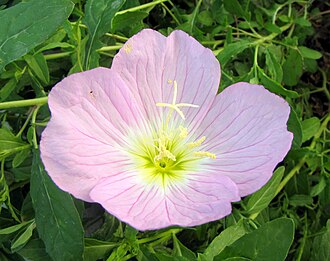
Pink evening primrose smothers itself in cup-shaped pink flowers in late spring, each one opening near dusk and lasting a single day. It spreads enthusiastically by both rhizome and seed — genuinely aggressive in good soil, and the main thing to weigh before planting it. Poor, dry ground keeps it in bounds and it flowers just as heavily there, so a lean site is a feature rather than a compromise. The flowers are worked by hawkmoths at dusk and by bees the following morning, unusual for an evening primrose. It goes dormant and disappears in midsummer heat, often returning with a lighter flush in fall. It is a larval host for several sphinx moths.
- Family
- Onagraceae
- Type
- shrub
- Lifespan
- perennial
- Height
- 0.75–2 ft
- Spacing
- 1–1.5 ft apart
- Light
- sun
- Soil moisture
- dry, moist
- Soil pH
- alkaline, neutral
- Bloom
- February, March, April, May, June, July
- Bloom colors
- white, pink
- Wildlife value
- songbirds, pollinators, larval host
- Caterpillar hosts
- ~16 butterfly & moth species
- Landscape uses
- naturalizing
- Native states
- AL, AR, AZ, CA, FL, IA, KS, LA, MO, MS, NC, NE, NM, OH, OK, PA, SC, TN, TX, UT
Related native plants
More Oenothera species
- Tufted Evening Primrose (Oenothera caespitosa)
- Common Evening Primrose (Oenothera biennis)
- Hooker's Evening Primrose (Oenothera elata)
- Scarlet Beeblossom (Oenothera suffrutescens)
- Birdcage Evening Primrose (Oenothera deltoides)
- Missouri Evening Primrose (Oenothera macrocarpa)