Starry Rosinweed
Silphium asteriscus
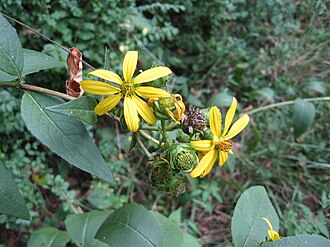
Starry rosinweed is the smallest and most tractable of the silphiums, reaching a manageable few feet where its relatives run to ten, and it flowers from early summer well into fall rather than in one burst. Its stems and leaves are rough as sandpaper, and cut stems bleed a sticky resin that gives the genus its name and once served as a chewing gum. The taproot goes down several feet, which is why an established plant is untroubled by drought and equally untroubled by attempts to move it. Goldfinches strip the seed heads through late summer and favor silphium seed strongly enough that leaving the stalks standing is worth more than deadheading. It takes a wider range of light and moisture than most prairie forbs, from open sun to real shade at a woods edge. It never runs and holds a tidy clump for decades.
- Family
- Asteraceae
- Type
- wildflower
- Lifespan
- perennial
- Height
- 2–5 ft
- Spacing
- 1.5–3 ft apart
- Light
- shade, sun, part shade
- Soil moisture
- moist, dry
- Soil pH
- acidic, neutral
- Bloom
- June, July, August, September
- Bloom colors
- yellow
- Wildlife value
- pollinators, butterflies, songbirds
- Landscape uses
- border
- Native states
- AL, AR, FL, GA, IN, KY, LA, MO, MS, NC, OK, SC, TN, TX, VA, WV
Related native plants
More Silphium species
- Cup Plant (Silphium perfoliatum)
- Compass Plant (Silphium laciniatum)
- Prairie Dock (Silphium terebinthinaceum)
- Wholeleaf Rosinweed (Silphium integrifolium)
- White Rosinweed (Silphium albiflorum)
- Whorled Rosinweed (Silphium trifoliatum)