Arrowwood Viburnum
Viburnum dentatum
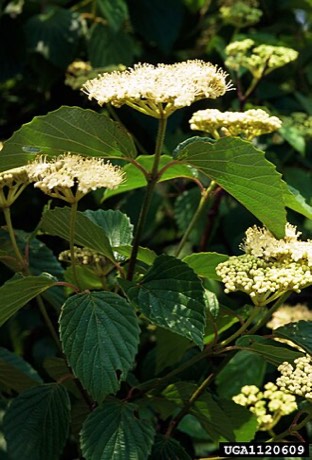
Arrowwood is named for the straight, unbranched young shoots that rise from its base each year and were used for arrow shafts; they also give the shrub its upright, multi-stemmed vase form. Flat white flower clusters in early summer draw a wide range of small bees, beetles and flies, and the fruit that follows ripens blue-black in early fall, high in fat and taken quickly by thrushes, catbirds and cardinals. Fruit set is far heavier with a second, genetically different plant nearby, so buy two clones rather than two plants from the same cutting. The berries are edible and pleasantly sweet, though there is very little flesh around a large seed. Fall color is reliable and runs to deep red and burgundy. It suckers steadily into a thicket, which makes it a fine informal hedge and a poor specimen for a tight bed.
- Family
- Viburnaceae
- Type
- tree
- Lifespan
- perennial
- Height
- 6–10 ft
- Spacing
- 6–10 ft apart
- Light
- sun, part shade, shade
- Soil moisture
- moist
- Soil pH
- acidic
- Bloom
- May, June, July
- Bloom colors
- white
- Wildlife value
- songbirds, butterflies, larval host
- Caterpillar hosts
- ~104 butterfly & moth species
- Landscape uses
- border, hedge or screen, naturalizing, rain garden
- Native states
- AL, AR, CT, DC, DE, FL, GA, IA, IL, IN, KY, LA, MA, MD, ME, MO, MS, NC, NH, NJ, NY, OH, PA, RI, SC, TN, VA, VT, WI, WV
Related native plants
More Viburnum species
- Mapleleaf Viburnum (Viburnum acerifolium)
- Hobblebush (Viburnum lantanoides)
- Blackhaw Viburnum (Viburnum prunifolium)
- Rusty Blackhaw (Viburnum rufidulum)
- Nannyberry (Viburnum lentago)
- Squashberry (Viburnum edule)