Swamp Onion
Allium validum
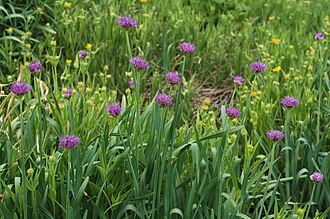
Swamp onion is a mountain wetland plant, growing in saturated meadows and along streams in the Sierra Nevada and Cascades at elevations where snow lies late, often in stands dense enough to scent the air when walked through. It is tall for a wild onion at about two feet, with dense rounded heads of pink flowers held well above the leaves. It grows from thick iris-like rhizomes rather than a tidy cluster of bulbs; the bulbs are somewhat fibrous but perfectly good as a flavoring in soups and stews, and the leaves are eaten as well with the raw flowers used as a garnish. The flowers are worked heavily by bumblebees and by the flies and small bees that dominate pollination at that elevation. It needs soil that stays genuinely wet all summer, which is the hard part to reproduce in a garden. As with all onions, keep it away from dogs, which are unusually susceptible to the genus.
- Family
- Amaryllidaceae
- Type
- wildflower
- Lifespan
- perennial
- Height
- 2–2 ft
- Spacing
- 0.5–1 ft apart
- Light
- sun
- Soil moisture
- moist, wet
- Soil pH
- acidic, neutral, alkaline
- Bloom
- June, July, August, September
- Bloom colors
- pink
- Wildlife value
- pollinators, butterflies
- Landscape uses
- border, container, rain garden
- Native states
- CA, ID, NV, OR, WA
Related native plants
More Allium species
- Ramps (Allium tricoccum)
- Wild Garlic (Allium canadense)
- Nodding Onion (Allium cernuum)
- Prairie Onion (Allium stellatum)
- One-leaf Onion (Allium unifolium)
- Largeflower Onion (Allium macropetalum)