Largeflower Onion
Allium macropetalum
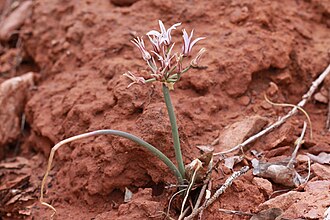
Largeflower onion is a small desert bulb that spends most of the year invisible underground, sending up a few grass-like leaves and a stalk of star-shaped pink flowers for a few weeks after the spring rains before vanishing again by early summer. The flowers are large for the size of the plant, which is what the name records, and each petal carries a darker midvein. It grows on dry mesas, gravelly flats and desert grassland across the Southwest, entirely dependent on winter and spring moisture. The bulbs are edible raw or cooked and can be dried for winter; they were often singed first to soften the strong flavor, and the leaves and flowers are eaten as well. Its early bloom makes it useful to bees emerging in a season when the desert has little else open. As with every onion, it is toxic to dogs.
- Family
- Amaryllidaceae
- Type
- wildflower
- Lifespan
- perennial
- Height
- 0.5–1 ft
- Spacing
- 0.3–0.6 ft apart
- Light
- sun
- Soil moisture
- dry
- Soil pH
- neutral, alkaline
- Bloom
- March, April
- Bloom colors
- pink
- Wildlife value
- pollinators, butterflies
- Landscape uses
- border, container
- Native states
- AZ, CO, NM, TX, UT
Related native plants
More Allium species
- Ramps (Allium tricoccum)
- Wild Garlic (Allium canadense)
- Nodding Onion (Allium cernuum)
- Swamp Onion (Allium validum)
- Prairie Onion (Allium stellatum)
- One-leaf Onion (Allium unifolium)