Shagbark Hickory
Carya ovata
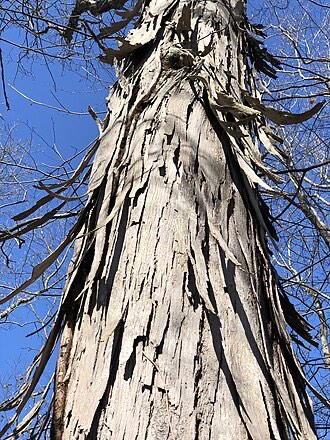
Nothing else looks like a mature shagbark: the gray bark separates into long vertical plates that curl away at both ends, loose enough that bats roost behind them. It is slow, deep-rooted and very long-lived, and it puts down a taproot in its first season, which is why nursery stock transplants badly and nuts sown where they are to grow do better. The husk splits cleanly into four parts to release a sweet, thin-shelled nut, the best-flavored of the native hickories and worth beating the squirrels to. The seed can also be ground into a meal to thicken soups, or pounded and boiled to separate a rich nut milk used like butter; the spring sap reduces to a syrup. Hickories feed a very large roster of native caterpillars, luna and regal moths among them. Fall color is a warm gold, and the compound leaves drop as whole stalks rather than as leaflets.
- Family
- Juglandaceae
- Type
- tree
- Lifespan
- perennial
- Height
- 70–90 ft
- Spacing
- 50–70 ft apart
- Light
- sun, part shade, shade
- Soil moisture
- dry, moist
- Soil pH
- acidic, neutral
- Bloom
- March, April, May, June
- Bloom colors
- green, brown
- Wildlife value
- butterflies, pollinators, mammals, songbirds, larval host
- Caterpillar hosts
- ~235 butterfly & moth species
- Landscape uses
- specimen
- Native states
- AL, AR, CT, DC, DE, GA, IA, IL, IN, KS, KY, LA, MA, MD, ME, MI, MN, MO, MS, NC, NE, NH, NJ, NY, OH, OK, PA, RI, SC, TN, TX, VA, VT, WI, WV
Related native plants
More Carya species
- Pecan (Carya illinoinensis)
- Bitternut Hickory (Carya cordiformis)
- Pignut Hickory (Carya glabra)
- Mockernut Hickory (Carya tomentosa)
- Black Hickory (Carya texana)
- Water Hickory (Carya aquatica)